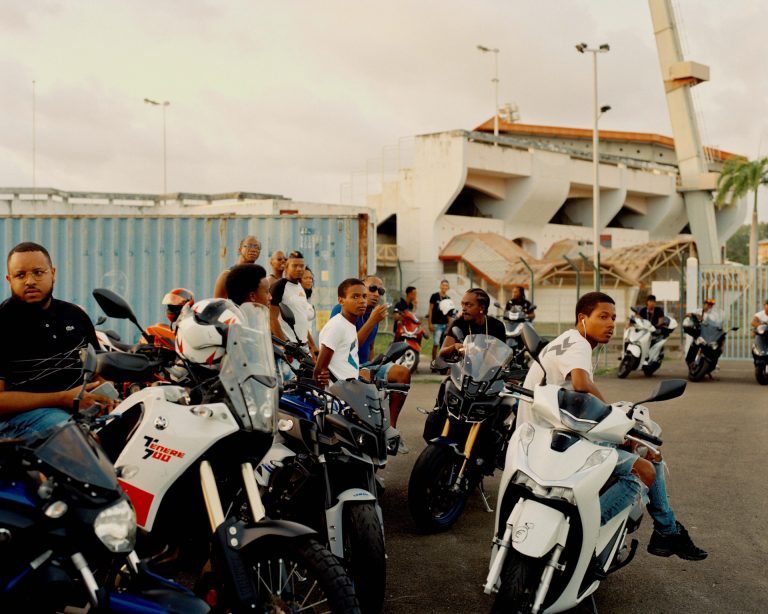
Trampoline supports the participation of artists Matthieu Kleyebe Abonnenc, Franky Amété, Raphaël Barontini, Jordan Beal, Minia Biabiany, Ernest Breleur, Jean-Marc Bullet, Gaëlle Choisne, Ronald Cyrille, Kenny Dunkan, Arthur Francietta, Gwladys Gambie, David Gumbs, Clémence Lollia Hilaire, Louisa Marajo, Manuel Mathieu, Jimmy Robert, Michael Roch, Cédrine Scheidig, Hervé Télémaque in the exhibition An Introduction to Van Lévé. Sovereign Visions from the Creole & Maroon Caribbean & Amazonia: Guadeloupe, Martinique, Guyane & Haiti: 2001-Now at the Alain Locke Gallery of African & African American Art, Harvard University, curated by Claire Tancons.
This support follows a series of artist encounters organised in 2018 for Claire Tancons through Trampoline’s curators invitation programme.
The first presentation of an ambitious multi-faceted curatorial project, Van Lévé at the Alain Locke Gallery brings together internationally acclaimed artists with connections to territories in the Americas formerly under French colonial rule, placing them in dialogue with landmark historical works. It provides a historical grounding and artistic genealogy that amplifies a renaissance of Creole, Maroon, Caribbean, and Amazonian voices. As France continues to reckon with its involvement in the Trans-Atlantic Slave Trade and colonial slavery on the twenty-fifth anniversary of the Taubira Law recognizing both as crimes against humanity, Van Lévé asks: how do artists, connected by their fraught past and present connections with France, deploy critical inquiry and aesthetic elaboration to forge emancipatory dreams that can be transformed into tangible sovereign visions?